

 One of the most difficult transitions in leadership is moving from representing your function to serving the enterprise.
Most managers are rewarded for protecting resources, advancing priorities, and advocating for the needs of their teams. Those behaviors are valuable. In fact, they are often essential. The challenge arises when every leader is doing a good job for their function, but no one is optimizing for the organization as a whole.
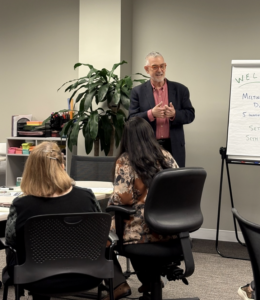
Recently, I designed an exercise to help leaders experience this difference firsthand. Here’s the flow:
Participants are divided into small groups and given a realistic scenario: A sizable infusion of money comes into the organization, but it is limited nonetheless and only a handful of initiatives can be funded. In the first round, each person is assigned a functional role such as Sales, Operations, Finance, HR, IT, Customer Experience, Products & Services, or Quality. Their task is simple: advocate for their area.
The results are predictable. Strong arguments emerge. Coalitions form. Competition for resources intensifies. Every recommendation is reasonable when viewed from the perspective of a single function.
The groups are asked to revisit the exact same scenario. This time they are told they will be evaluated solely on enterprise outcomes. Functional interests become secondary. The question shifts from “What’s best for my area?” to “What’s best for the organization?” Leaders begin weighing tradeoffs differently. They look for interdependencies. They consider second- and third-order effects. They become more willing to sacrifice local gains in pursuit of larger organizational wins.
The lesson is simple but powerful: Enterprise leadership is not the absence of advocacy. It is the ability to hold advocacy and organizational stewardship at the same time.