

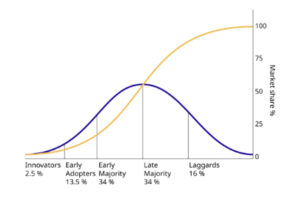
 Successful change ultimately rests on the support of the people who are responsible for implementing it. Without their buy-in, even the most promising initiative will stall. This is why leaders must be strategic in how they communicate and introduce new ideas. One of the most common mistakes I see is trying to convince everyone at the same time or spending precious effort on the Late Majority and the Laggards (definitions of these terms are below). Change requires a phased communication and outreach program that meets each group where they are.
A tool that has served me exceptionally well in this work is Everett Rogers’ theory of the Diffusion of Innovation. It explains how new ideas, products, and practices spread through a social system over time. When you understand how adoption unfolds, you can time your messaging, focus your energy, and build momentum in a deliberate way.
The first group to reach out to is the Innovators. These are the individuals who leap toward new ideas before anyone else sees the opportunity. They live on the frontier where the risks are high, but the potential payoff is extraordinary. Innovators represent just 2.5% of the population, yet they are critical because this is where you first get traction. The message for the Innovators is, “We have something new and amazing, and we want you to be the first to try it.”
Next come the Early Adopters. They may not want to live on the bleeding edge, but they are eager to embrace new ideas, processes, and tools once they are formed enough to test. They make up 13.5% of the population and they help refine the innovation and prepare it for broader use. For Early Adopters, the message is “It is here, it is working, and we have addressed the major problems. Help us refine this and get it ready for prime time.”
After that comes the Early Majority, a large group at 34%. These individuals adopt new practices once the kinks are worked out and the results are clear. They want evidence that the innovation is stable and that the benefits outweigh the costs. They rely on the experiences of Innovators and Early Adopters, which you must synthesize into a simple, digestible message. For the Early Majority the message is “We have figured out what works and what does not. Here is the cost benefit analysis. Please implement the parts that add value.”
Once these three groups are on board, you have reached the fifty percent threshold. You now have 50% of your market share; your market being the people who will change their behavior. This is the point of critical mass. When you reach this point, the likelihood of success rises dramatically because the social system begins to carry the innovation forward on its own.
Next comes the Late Majority, another 34% of the population. They only adopt the change once it is no longer considered new. For the Late Majority the message is “This is now the way we work.”
Finally, there are the Laggards, 16%. There is no message for them. Leave them alone. They may never change and that is fine. They provide stability to the system and serve as a counterbalance to rapid or impulsive shifts. Unless you have major influencers in this group, they will not undermine your success. For more on dealing with apathetic, agnostic, and antagonistic, see my book, Getting Change Right, on Amazon.
Everett Rogers’ model offers a clear map for engaging the people who matter most across the life of any change initiative. If you tailor your communication to the right groups at the right time, you give your effort the support it needs and dramatically increase the odds that the change will take root and thrive.