
 Where are you on the AI curve right now?
 Most organizations today are experimenting with AI. They are testing tools, automating tasks, and looking for ways to improve efficiency. That is where the conversation usually starts. It is not where the real opportunity lies.
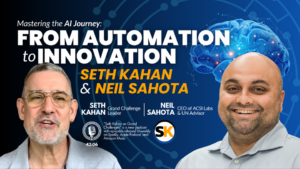
In my recent conversation with AI expert Neil Sahota, he described AI as a progression that organizations move through over time:
Awareness. Adoption. Adaptation. Autonomy.
Most organizations are still in the early stages. They are building awareness and beginning to adopt AI tools. Some are starting to adapt how they work. Very few are operating at a level where AI is deeply embedded in how work gets done. That progression matters because it shapes how leaders think about what is possible.
At one point, Neil shared a simple but powerful idea: You cannot continuously improve a candle and expect to get a light bulb.
This is where I see many leadership teams getting stuck. They are applying AI to existing workflows, optimizing what already exists, and calling it progress. And to be fair, it is progress. But it is not transformation.
Neil’s work points to something more. As organizations move from adoption to adaptation, the question shifts. It is no longer just, “How do we use AI?” It becomes, “What becomes possible if we rethink how this work gets done?”
In our conversation, he grounded this in real examples. AI is expanding access to healthcare in parts of Africa, supporting people with hearing challenges in Korea, and helping financial institutions detect fraud in ways that were not previously possible. He also pushed beyond the hype around the metaverse, showing how it is already being used in practical, high-value ways.
Neil offered a framework to help leaders think more expansively, one that challenges teams to move beyond familiar patterns and consider entirely new approaches. What stood out to me is this. AI does not create transformation on its own. Organizations progress toward it. And that progression requires leaders to do more than introduce new tools. It requires them to reconsider how work is designed, how decisions are made, and how value is created.
If you are leading change right now, this is the real question: Where are you in this progression, and what would it take to move forward?
If this sparked something for you, I am now partnering with Neil Sahota to lead a specialized executive workshop designed to move organizations from AI curiosity to real strategic advantage. In a focused working session, we help leadership teams assess their AI maturity, identify high-value opportunities, prioritize the initiatives that matter most, and define a clear 90-day activation plan that connects directly to business outcomes. If you are ready to move beyond experimentation and start building AI into the core of how your organization creates value, reach out to me, and I would be glad to share more.